
India's external debt rose by 8.2 per cent year-on-year to $620.7 billion as of March 2022, which according to the finance ministry is sustainable. While 53.2 per cent of it was denominated in the US dollar, Indian rupee-denominated debt, estimated at 31.2 per cent, was the second largest, as per the status report on India's external debt released by the ministry. "India's external debt continues to be sustainable and prudently managed. As of end-March 2022, it stood at $620.7 billion, growing by 8.2 per cent over the level a year ago.

India's forex reserves recently declined by $704 million to $354.517 billion.

Fitch Ratings has upgraded Reliance Industries Ltd's (RIL) rating to 'BBB', one notch above India's sovereign rating, as the company benefits from cash flow generation across diversified business segments and continuation of deleveraging. In a statement, Fitch said it has upgraded RIL's long-term foreign-currency issuer default rating (IDR) to 'BBB', from 'BBB-', with a negative outlook. At the same time, the agency has affirmed RIL's long-term local-currency IDR at 'BBB+' with a stable outlook.

India's economic growth is now 'extremely fragile' and needs all the support that it can get, as private consumption and capital investment are yet to pick up, RBI Monetary Policy Committee (MPC) member Jayanth R Varma said on Friday. Varma further said out of the four engines of growth for the economy, exports and government spending supported the Indian economy through the pandemic, but other engines need to pick up the baton now. " I like to think in terms of the four engines of growth for the economy: exports, government spending, capital investment and private consumption. "...while exports cannot be the main driver of growth because of the global slowdown, government spending is necessarily limited by fiscal constraints," he told PTI.

Finance Minister Nirmala Sitharaman presents her fourth Budget in Lok Sabha on Tuesday.
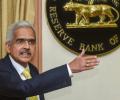
The board deliberated on the governance framework of the RBI and it was decided that the matter needs further examination

The dollar index was up by 0.43 per cent against a basket of six major currencies as euro dropped against the dollar, after quarterly economic reports from France and Germany missed expectations, said analysts.

A sharp sell-off in the Indian equities markets after a spike in crude oil prices should not be surprising. Historically there is a negative correlation between stock valuations in India and the price of Brent crude oil, which is the benchmark for the Indian crude oil basket. Between 2011 and 2014, crude oil traded above $100 a barrel for an extended period, the Sensex-trailing price/earnings (P/E) was 18X, on average, during the period, nearly 22 per cent lower than the current index P/E of 23X.

As many as 37 per cent of smartphones sold in India in 2022 cost Rs 15,000 or more.

Covid-19, US yields, dollar to weigh on equity flows in the near term.

'I was stunned when he started crying and profusely apologising to me, begging me not to lodge a complaint against him because he is a family man and did not want his wife and child to be affected by this incident'

That's the only way to convince those who have money to return to the bank fold, ditching other asset classes, says Tamal Bandyopadhyay.

The Indian services sector activity fell to a six-month low in September, as new business inflows rose at the slowest rates since March, amid inflationary pressures and competitive conditions, a monthly survey said. The seasonally adjusted S&P Global India Services PMI Business Activity Index fell to 54.3 in September, from 57.2 in August, highlighting the weakest rate of expansion since March. For the fourteenth straight month, the services sector witnessed an expansion in output. In Purchasing Managers' Index (PMI) parlance, a print above 50 means expansion, while a score below 50 denotes contraction.

The benchmark Sensex is 2.4 per cent shy of a new lifetime high but the market capitalisation (m-cap) of all companies listed on the BSE is already in the record books. At Thursday's (August 18) closing price, the total m-cap of 4,776 firms on the BSE stood at Rs 280.5 trillion, surpassing the previous high of Rs 280 trillion on January 17. This, even if the Nifty Midcap 100 is currently 5.4 per cent below its lifetime high, while the Nifty Smallcap 100 index is down over 20 per cent.

Some leading Indian companies are likely to see their earnings declining if the Indian currency depreciates further, analysts and finance heads say.

According to the Centre's legislative business list for the upcoming session, three bills have also been listed to replace three ordinances.

Indian companies are planning to increase investments in the new year to expand capacity, acquire companies, and go on a hiring spree, a survey of top executives showed. They, however, cited rising costs, weak consumer demand, and increasing interest rates as major concerns for 2023 which may impact their plans.

'While Kejriwal has lost his credibility due to his failure in Delhi, Captain Amarinder Singh is dancing on the tune of his image managers.'

After a turnaround in performance by Indian equity markets since July that has seen the S&P BSE Sensex and the Nifty50 wipe out the year-to-date losses, analysts suggest investors start nibbling into stocks that are focused on the domestic economy. While they say intermittent corrections, led by policies of global central banks and other economic data, cannot be ruled out, analysts expect India's relative outperformance among global equity markets to continue as it looks better placed with a healthy economic recovery, and remains one of the fastest growing major economies. In this backdrop, Neeraj Chadawar, head of quantitative equity strategy at Axis Securities, believes that amid global slowdown, aggressive tightening by the central banks, and preference for domestic interests first (by the local government), export-oriented themes are likely to be muted or will deliver conservative returns in the near-term.

Failure to reinstate salary even two years after the drastic cuts has landed the airline industry in a massive industrial relation crisis. While employees of Air India had organised a strike back in 2011, it is for the first time that private airlines are facing serious stress related to workers. IndiGo witnessed two of them, back to back. In the first instance, around 50 per cent of the IndiGo flights were delayed as a large number of crew members went on mass sick leave, apparently to participate in a rival airline's walk-in job interview.

The country's foreign exchange reserves surged by $58.38 billion in April-September 2021 to $635.36 billion, says an RBI report released on Wednesday. The forex reserves were at $576.98 billion at end-March 2021. The Reserve Bank of India (RBI) publishes half-yearly reports on management of foreign exchange reserves.

Foreign portfolio investors (FPIs) turned net buyers in October after being net sellers in the previous month. In October, FPIs bought shares worth nearly Rs 8,430 crore ($1 billion) against net selling of Rs 13,405 crore ($1.6 billion) in September. Positive flows during three of the previous four months have pushed the domestic markets towards fresh all-time highs. At present, the Sensex and Nifty are less than 2 per cent shy of breaching record highs logged in October 2021. A rally in equity markets in the US and Europe is in hopes that the Federal Reserve may go soft on rate hikes after its November meeting.

Two players were arrested on charges linked to violation of foreign exchange laws.
The Securities and Exchange Board of India's (Sebi's) board on Wednesday allowed foreign portfolio investors (FPIs) to trade in exchange-traded commodity derivatives. The move, it said, "will enhance liquidity and market depth, as well as promote efficient price discovery." Overseas investors will only be allowed to deal in non-agricultural commodity derivatives and only cash-settled contracts.

NSE managing director and CEO Vikram Limaye on Wednesday said that he will not seek a second term at the stock exchange when his five-year term ends in July. This comes amid the National Stock Exchange (NSE) facing the regulatory probe in a case related to governance lapses at the bourse as well as in the co-location matter. "I have informed the board that I am not interested in pursuing a second term and will therefore not be applying and participating in the process that is underway. My tenure ends on July 16, 2022," Limaye said in a statement.
Expressing his satisfaction over the government's move to slash fiscal deficit target, Das said it will help improve investment by the private sector as crowding out impact will be less.

India's traditional PC market, inclusive of desktops, notebooks, and workstations declined by 11.7 per cent year-on-year (YoY) in Q3CY22 (Jul-Sep) after 8 consecutive quarters of growth despite strong shipments of 3.9 million units, according to new data from the International Data Corporation (IDC) Worldwide Quarterly Personal Computing Device Tracker. All segments declined except the government, which grew by 91.5 per cent YoY on the back of government orders, leading to strong growth in the third consecutive quarter. While the desktop and workstation categories grew by 23.4 per cent and 17.6 per cent YoY respectively, the notebook category declined by 19.5 per cent YoY.

The net outward foreign direct investment went up from $9.1 billion in 2017-18 to $12.6 billion in 2018-19 and moved further north to $13 billion in 2019-20.

If the CBDCs don't offer interest, why will people shift from cash to CBDCs?, asks Tamal Bandyopadhyay.

In 2017, when Infosys announced that Salil Parekh would be its next chief executive officer (CEO) and managing director (MD), very few in the industry or the analyst community doubted his ability to bring the company back to a healthy growth trajectory, improve morale within the company and, more importantly, win the promoters' trust and investor confidence. There were reasons for this confidence. He was not only the deputy CEO of the Paris-headquartered IT services major Capgemini, but also one of the only non-European faces on the executive board of the company.

A new mobile banking 'Trojan' virus -- SOVA -- which can stealthily encrypt an Android phone for ransom and is hard to uninstall is targeting Indian customers, the country's federal cyber security agency said in its latest advisory.

The balance sheet of the Reserve Bank plays a critical role in the functioning of the country's economy.

India ranks 51st in annual appreciation in housing prices with a 2.1 per cent rise in rates during the October-December quarter of the last year, according to property consultant Knight Frank. In its latest research report titled 'Global House Price Index - Q4 2021,' Knight Frank said that India has climbed up five spots to the 51st rank in Q4 of 2021 against the 56th rank in Q4 of 2020. Turkey witnessed the highest annual price growth rate by 59.6 per cent in the year to Q4 2021, followed by New Zealand (22.6 per cent), Czech Republic (22.1 per cent), Slovakia (22.1 per cent) and Australia (21.8 per cent).

The branch managers have come out of their glass cabins and the sellers' market has transformed into a buyers' market, but there is no end to the harassment of customers, asserts Tamal Bandyopadhyay.

New Delhi slipped by two positions to rank 39th globally in terms of price appreciation of prime residential properties during the September quarter, according to Knight Frank. Mumbai ranked 40th, same as the June quarter, while Bengaluru moved up one spot to 42nd rank. New Delhi stood at the 37th rank, while Mumbai and Bengaluru were at 40th and 43rd positions, respectively, during the second quarter of 2021 calendar year. In its 'Prime Global Cities Index Q3 2021' report, Knight Frank tracked the movement in prime residential prices in local currency across 45-plus cities worldwide.

Continuing its heavy selling spree for the eighth consecutive month, foreign investors pulled out nearly Rs 40,000 crore from the Indian equity market in May on fears of an aggressive rate hike by US Federal Reserve that dented investor sentiments. With this, net outflow by foreign portfolio investors (FPIs) from equities reached at Rs 1.69 lakh crore so far in 2022, data with depositories showed. Going ahead, FPI flows will remain volatile in the emerging markets on account of rising geo-political risk, rising inflation, tightening of monetary policy by central banks, among others, Shrikant Chouhan, Head - Equity Research (Retail), Kotak Securities said.

What's the real reason behind ATMs running dry even in states that are not election-bound, wonders Nivedita Mookerji.

Paytm has, since November 8, been on an overdrive, rolling out a series of features on its app including multi-language options for a no-holds barred access across the country. The company is now planning to make Paytm available on all types of mobile phones, going much beyond smartphones.


Gold prices are struggling and are down 18 per cent from their March highs. But stock prices have fallen even more. As a result, the precious metal has begun to outperform equities - both in the domestic market and international markets. Gold prices are up 2.6 per cent in the domestic market in the current calendar year (CY22) so far, according to the World Gold Council (WGC), compared to a 1.7 per cent decline in the Sensex year-to-date (YTD).
